
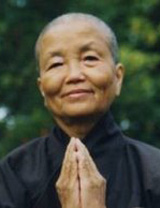
Sister Chan Khong
Sister Chan Khong is the rock behind one of the greatest teachers on this planet – Thich Nhat Hanh – who has been working for peace for over sixty years. He is the founder of Plum Village in France, where people gather from all over the world to learn the art and practice of mindfulness. Thich Nhat Hanh was nominated for the Nobel Peace Prize by Dr. Martin Luther King, Jr., who was very impressed with his work.
Sister Chan Khong supports Thich Nhat Hanh in bringing forth the teachings of mindfulness, receptivity, healing, and true listening. She ushers in timeless wisdom, tools, and teachings for peace. Without her, he would never be able to achieve such a large scope of work. On September 11, 2004, I had the privilege of talking with her at Plum Village, where she shared her inspiring perspectives on transmuting hate, war, discord, and suffering. If you are interested in manifesting peace in everyday life, Sister Chan Khong and Thich Nhat Hanh offer an extraordinary and practical framework.
Peace is crowning as a human and global imperative for the prosperity of civilization. Join us with Sister Chan Khong as we unveil the next step for humankind with this remarkable teacher.
Podcast: Play in new window | Download
Original air date: 9/11/2004
Read Full Transcript
It’s Rainmaking Time!
The Practice of Peace — Sister Chan Khong
Recorded September 11, 2004 · Host: Kim Greenhouse
Kim Greenhouse: Peace is an art form and a practice that takes receptivity and mindfulness. Good morning, ladies and gentlemen, you are tuning into It’s Rainmaking Time! We are broadcasting this special segment, September 11, 2004, on the World Wide Web. For those of you who are listening, I know that you know that September 11, 2001 was one of the most shocking, devastating times in human history in the United States of America and around the world. And we know that most of us hope for peace. Some of us understand it. Many of us want it on deep levels, and billions of us talk about it. Most of us also know that most elected leaders face a very, very difficult time in that those of them who stand by and allow hundreds and thousands of people to be murdered will be thought of as weak, as inept, and as inappropriate for a leadership position. The forces facing our leaders today are terrible. They’re antiquated. They come from an old guard mentality and a misunderstanding of power — what it’s about, how it’s navigated, and how to use it.
Our guest today is a devoted leader, a teacher of peace, of what is called the art of living. In my adult life, I have had the privilege of meeting wonderful teachers, but I have never borne witness to the power, the kindness, the gentleness, and the humility of my guest and her associate, Thich Nhat Hanh. The woman you’re about to meet today is the woman beside Thich Nhat Hanh — a spiritual leader, a man of peace, a man who has transmitted the composition of peace, the tools of peace, and the art of living like few can. Ladies and gentlemen, please welcome today, from Plum Village in France, just outside of Bordeaux — Sister True Emptiness, we call her Sister Chan Khong. Good morning and welcome to It’s Rainmaking Time!
Sister Chan Khong: Welcome. Good morning. My name is Chan Khong, and I am very honored to be able to talk to you. I hope that my message can get through. I know that this morning in New York at 9 a.m. is our time in France, 3 p.m., and we know that three years ago, at that very moment, people suffered a lot, and so our teacher Thich Nhat Hanh and all of us go and burn incense and send our loving thoughts and support to those who pass away that day, and to the relatives of those who passed away that day. And we know that in the offering of incense, we address those who are victims of that day — we say that friends, you are no longer there in the form of yourself, and people call you by your name. But your spirit is in all of us, in the world. And we think of you, we pray for you, we support you, and your spirit is still alive in us. And we vow to do something wonderful so such a tragedy will not happen again.
And when we pray like that, we know that at this very moment, people still suffer. There is no explosion in New York, but there is a lot of suffering in Israel, in Iraq, in Afghanistan, and in many parts of the world. And we wish that we will be able to offer to you some method so you may face the difficulty with more calm, in a dignified way. Buddhism is not a religion. You can remain Islam, Christian, Jewish, non-believer, but you can make use of a number of methods offered by the Buddha. In fact, the word Buddha means the person who is awakened and sees deeply things with compassion and great understanding. So all of you can become a Buddha, and you can practice like that first Buddha. We all here, we try to practice like him. Among us in Plum Village, there are Christians, there are Jews, there are non-believers, and we train ourselves, and it’s work.
You know, two partners live together, have difficulty, but we live together — I’d say 155% — in Plum Village, but we are still happy. And we try to face the difficulty between us with understanding. And finally, we always try to keep harmony without being forced to do so.
I would like to tell you what lesson we can learn from September 11, 2001. As a simple person, I would like to invite you to practice something: you look deeply — the United States is considered like the safest country, but even the United States is no longer safe from being attacked by terrorism. There is uncertainty of safety everywhere. You can hug your son today and say goodbye to him, but when he goes out he has a car accident and he can die. We would like to remind people: don’t wait until the suicide bomber or a holdup arrives near your beloved one, and then you say, “I love you, mom. I love you, son.” It will be too late.
So my suggestion is, today, before midnight, each of you try your best to reconcile and to say deeply and lovingly to the person you love, but with whom you have some difficulty — let’s say you have a teenage son who ran away, or your daughter who disobeyed you and ran away. Deep inside you love her, or you love him, but you don’t want to tell him. Don’t wait until he is caught in a holdup and then you say, “I love you.” Right away after this session with me, try to call him, try to find her, and say, “I love you, dear. I really care for you.” It will not be too late, if something happens to her. But if nothing happens to her or to him, you will have a wonderful son again, a wonderful daughter again. When she has some difficulty with you, she thinks that you hate her, and you have been reluctant to tell her. But deep inside, I know that you love her, or you love him. So try to say it right away after this session.
Or with your mother, or your father — you are a grown person, but your mother keeps correcting you, and sometimes you are not happy with her or with him. And especially with your father — he looks a little difficult, and you don’t want to tell him that you love him. You are a man, you cannot say “I love you” to another man, even if he is called your father. Please do it. Do it right away. Try to call him and say, “Dad, I care for you, I love you a lot.” Even if you think it’s very difficult, try it. Visualize that if he is caught in a holdup in a supermarket, then it’s too late for you to tell him. So please do it right away, to your father, to your mother.
And then to your partner — if you’ve just fallen in love, or you just married, you are in very good terms with each other, but sometimes we live together for five, six, seven years, and it becomes like a routine, and we forget to tell him, to tell her, how much we care for him, we care for her — until one day he decides to leave you, she decides to leave you. Because the first day we fell in love, we always appreciate and look at the other with admiration. But slowly, slowly, it becomes like a routine, and you only voice your disagreement when he doesn’t do as you wish, when she doesn’t do as you wish. But when she has done, or he has done, something wonderful, you forget to appreciate and deeply acknowledge him. So today, try to tell him, or tell her, a number of great things she has done, he has done, that you haven’t had the chance to speak to him about yet. Tell him not only with your words, but with your deep look of appreciation, with your whole being, and it will make him very happy. It will make her very happy.
And also, I would like to invite you — if you have done something unskillful and you feel bad but are too shy or too proud to tell him, don’t wait until he or she is caught in a holdup to say “I love you.” No, you have to say it right now, and you apologize. You say, “Oh, I was so unskillful. I caused so much suffering. Please excuse me. I really care for you, and I wish that I would not repeat these mistakes again.” And if you can do that — sometimes you vaguely know that she’s unsatisfied with your behavior, or he is unsatisfied with your behavior, but basically you don’t remember what you’ve done, and you live together under the same roof but don’t really share the deep sharing you had in the first days. So now is the time you can sit, face to him or to her, look deep into her eyes, and say, “Darling, I really love you, but I know that I’m so unskillful and I may hurt you a lot without noticing. Please help me to understand you better.” Because, according to the teaching of the Buddha, love must go together with understanding. If you love your son, your daughter, but you don’t know the deep desire in him or in her, you do not really love your son or your daughter. You do not really love your partner. So you can look deep into his eyes, or her eyes, and say, “Darling, I really want to understand you, in order to show my full support of your deep aspiration. But I was too busy, and we are too busy, and we do not have time to really share what is very deep in us. So please tell me what way I can help you be happy, to show my deep understanding of you.” And if you can do that, it will surprise him and make him happy, and the relationship will be renewed again.
This is the word you who knew to say it in the past, but now you forget. So I see the occasion of September 11th as a reminder that everything is uncertain. Everything can happen — a car accident, a holdup, anything can happen, and you will regret it. So don’t wait until things happen like that, and you cry, “Oh, I didn’t say that to him. It’s too late now.”
Kim Greenhouse: Stand by, ladies and gentlemen, you are tuning into It’s Rainmaking Time! This is a webcast of today’s segment on practicing peace with Sister Chan Khong, out of Plum Village, just outside of Bordeaux, France. Sister Chan Khong is called Sister True Emptiness, and what a paradox it is — how somebody so true and empty can be so full of wisdom and kindness and knowledge. Their work is about teaching love and beauty and the art of living, mindfulness, and peace. They have done so beautifully for the last 45 years. In 1959, when Thich Nhat Hanh and Sister Chan Khong met, a new universe of the potential for peace was born. Sister Chan Khong, I was wondering if you could tell the audience a little bit about your humble beginnings in Vietnam, where you actually began in the villages, so they have a context for you.
Sister Chan Khong: I was born in Vietnam, in a middle-class family. I had everything — I had something to eat when I was hungry, I had schooling, I attended high school and university. But deep inside of me, I looked deep and saw that there was something unfair, because I was born during the war in Vietnam, and my family lived in the city. It was quite safe. And around me — bombing, guerrilla killing, and a lot of people died far away. I knew that far from my city there was silent murder, and the corpses of soldiers of both sides thrown into the river, floating dead.
So I felt that I must do something. At a very young age — sixteen, teenage — I felt that I must do something. I started to go to the slum areas where children had no school and couldn’t go to school. They had nothing to eat, and sometimes they went out and tried to beg for money or food, and if they couldn’t beg, they would pickpocket. So I tried to set up work there. I raised some money to give a scholarship of food for children, so that they must go to school. If I give you 30 pounds of food a month, and some pocket money to use — and then how could I have this food? In Vietnam we eat rice, and before cooking rice, people have raw rice. I went to each house and said, please consider me like a bird — after cooking your rice and after eating, there are a few grains of rice left in your pot, and consider me like your bird. So you take a handful of raw rice and put it in this packet for me. I wished that you could give me one dong — one dong in Vietnam at that moment is like 25 cents in the United States. And they said, “Oh, so few, I can give you $5.” I said, “No, I want only 25 cents — but your daughter, 25 cents, your son, 25 cents, your husband, 25 cents, your sister, your servant, your cook” — everyone in the family would give me 25 cents, so finally I would have five dollars.
Kim Greenhouse: You’re a big fundraiser! My God, I’m coming to France immediately for my 25 cents.
Sister Chan Khong: And then, with this money, I tried to set up small businesses for people who lived in the slum area and had no job. I pretended to be like their little niece — and you cannot trick a niece. I said, I have no money, I will borrow money from my relatives, and I will find a job for you. For instance, you go and sell ice cream — do you like to sell ice cream? And the man is very lazy, he plays cards, maybe he’s a pickpocket or a thief, I don’t know. But I said, please do some job. He said, I have no money. I said, I can find a way to buy you an ice box. He said, okay, give me money. I said no, I will go with you. So I brought him to the market and bought a big ice box, and ice cream sticks, and I said, you sell, and in the evening, give me back one dong to pay your debt.
Kim Greenhouse: You have a great banking system there — you set up a bank, a venture capital fund, a placement agency. You’re pretty incredible.
Sister Chan Khong: I created a lot of little jobs like that. And then I saw that some women had a baby and didn’t want to work, and I said, why don’t five of you put your five babies together — one will take care of them, and four others go to work, and in the evening you give the other woman some money. So I organized that in a small hut, and it transformed into a daycare center. I brought milk powder, because in Vietnam there aren’t many cows for milking — milk powder and vitamins, to nourish these children.
I had done quite a good job, until I met Thich Nhat Hanh. He said, your work is beautiful, but you are alone. I know many good-hearted people like you throughout the country, and I can use Buddhist teaching to set up the School of Youth for Social Service, and bring all of you together, and we make a kind of social change from the basic teaching of the Buddha — help yourself, and don’t wait until people come to help you, because in each of you there is a reality of understanding and love. In each of you there is God in you, and you have all the talent, all the ability, if you know how to restore that talent and that ability. So, together with Thich Nhat Hanh and a number of friends, we set up the School of Youth for Social Service during the war. We sent hundreds of people into the war zone, like a Peace Corps, to rescue war victims, make bandages, bring them across the fire zone to the hospital to be healed. And in the safe areas, we set up reconstruction work — in poor villages with no school, we said, don’t wait for the government to help you, because the Buddha said you are the future Buddha, you have the talent. Let’s build our own school, on our own veranda. We brought children together and found volunteers to teach.
And we tried to raise money to pay the school teachers. Forty years have passed, and I am still helping 1,078 school teachers throughout Vietnam now. This work is not supported by the Vietnamese government — they know about it, but we don’t need a big label saying Plum Village did this work. In the remote areas where there is no school, our social workers came and said, please set up the school yourselves, in a very humble hut, and we will pay for the teacher. When the farmers saw the teacher doing good work, they felt inspired, and built their own school. And when the school could go on by itself, we left and started in another area.
So, I go back to that work, and this is what Thich Nhat Hanh and I practiced, and what I want to share with you today. Every one of you can do it. When you are stuck by strong emotion — big anger, how could people kill my daughter in such a horrible way, how could he or she behave like that — when you are stuck by strong emotion like that, the Buddha said that at that moment, God is covered up. The reality of God in you is covered up. The Buddha in you is covered up. You cannot be clear-minded, and you will act wrongly, and make many mistakes. At that moment, the Buddha proposed touching your own Buddha, that source of understanding and love and light — if you are not Buddhist, you can call that God in you. How is it that Buddhists speak so much about God? The Buddha is the one who discovered that each human being can have a reality of understanding, of love, of light, in him or her. But because we don’t practice to discover that reality, we let anger, worries, and negative energy cover it up, and we have no chance to be in touch with it. In Christianity or other faiths, you feel that when you are at your best, full of light, of peace, of love, of understanding, God is living in you. That’s right. That reality is God in you. In Buddhism, we call it the Buddha in us. Your own Buddha. If your name is Elizabeth, there is a Buddha called Elizabeth. If your name is Jean, there is a Buddha called Jean. The practice is how to touch that Buddha in you.
Kim Greenhouse: Sister Chan Khong, many of us around the world are watching television, reading the papers, listening to the radio, as informed and well-intentioned citizens. As we do that, every day, or a few times a week, we are bearing witness to the horrors of what’s going on in the world from the media’s point of view. Many of us are riled up every day, very upset, watching beheadings, watching killings, listening to different leaders across the world taking a stand and going after, quote, “evil” people. It’s a runaway effect, it has a life of its own now, and many of us can’t help but be drawn in, wanting to retaliate, or wanting our governments to retaliate to stop the horrors. So I wanted to ask you a very difficult, direct question: what is your recommendation to the United States administration and government, on a leadership level, in terms of how to guide the American people — Republican or Democrat — who are looking to their leader to be, quote, “strong,” and to take action in a military way against the people considered evil? What’s your guidance to us, to the U.S. government right now?
Sister Chan Khong: I think we only need to look deeply, since the day the President of the United States started the war in Afghanistan, and then Iraq, and supported violence everywhere — this is the war against terror. But this war does not lead to more peace. This war only brings more terror. Have you seen that, since he started that war against terror, has peace arrived anywhere?
Kim Greenhouse: No, I haven’t.
Sister Chan Khong: And that is the time for us to stop, and to look deeper, in order to be clearer in our mind. We said we fight against terror. These innocent Afghans, these innocent Iraqi women and children, saw bombs drop on them, and they thought, that is terror. We said we fight against terrorists, but in fact, our sons sent to the army drop bombs and shoot. The Afghans, the Iraqis — we are terrorists to them. Have you seen that? They suffer so much, and in our point of view, we think they are terrorists, potential terrorists, but for them, we are the terrorists. We are evil — we call them evil. I mean the West, the countries that support the United States in the war on Iraq. We call them evil, but they see our evil. When soldiers come to Iraq, they say, “God bless America for this wonderful work.” But the suicide bomber, when he holds the bomb and kills himself, says, “Allahu Akbar, God is great.” Allah is another term for God. “God bless America.” “God is great.” Our Arab friends call God great. Our American friends call for God’s blessing on America. So where is God? I think God is love, is life. God will not bring violence to people like that, and God has a way to transform a so-called terrorist into a loving person.
Kim Greenhouse: Do you really think that’s possible?
Sister Chan Khong: Yes, that is possible. If I tell you my own experience — one day, in Vietnam in 1966, I was working in a poor village, about 20 kilometers from Saigon, and I went there by motorbike to help poor patients, to run a school and a medical center. We had been at peace there for a year of work. That morning when I arrived, I saw about 40 American soldiers. They looked like terrorists. They had guns, and they were ready to shoot at me, to shoot every villager around us. When they heard my motorbike arrive, they came toward me with guns, about to shoot. I was panicked, of course, like anyone — I’m not an angel, I’m not a bodhisattva. The training I learned is: when I am panicking, when I am struck by strong emotion, fear, anger, I go back to my breath. Breathing in, I calm myself. Breathing out, I relax. I try not to act, not to speak, not to do anything — just go back to my inner calming, relaxing.
So when I went back to myself, my face became calm, peaceful. My face was not provocative. It’s difficult for a soldier to shoot someone whose face is so peaceful. After breathing in and out for a while, I was so peaceful, and I looked deep, my mind became clearer. I looked into the eyes of the soldier. His eyes were very fearful, very fierce, but full of fear. Suddenly I had great compassion for him. I felt, well, he looks so young, like my brother. But if my brother were killed, my mother would cry. So if something happened to him, his mother would cry, in the United States. I looked at him and spoke kindly, gently to him. Fortunately, at that time my English was still poor, but I could express myself. I asked, “What are you trying to find?” He looked at me, very surprised that somebody could speak English. He was more fearful, but my voice was so soft and nice.
He said, “I’m trying to find communists.” I said, well, I have been working as a social worker here for more than a year. I have seen no communists. But two days ago, a group of guerrillas came and wanted to burn the houses of the village. The villagers begged them not to burn, because the roofs were thatched — if one house burned, the whole village would burn. So the guerrillas agreed not to burn, and they left. He listened to me, and called his men, and many of them came and asked me the same question. I explained, and they searched the area, because nearby there was a bridge that had been mined by guerrillas, so they thought the whole village was communist. At that moment, if some villager, out of anger or forgetfulness, made a loud noise, the panic in these soldiers could transform them into terrorists, and they would shoot the whole village. That happened during the war in Vietnam — at My Lai, several hundred people were shot by an American captain, because he panicked. Violent anger and fear can only bring tragedy, which is why this practice of peace is so important. You’re trying to find the book — it’s called Peace Is Every Step, by Bantam Books, and also Creating True Peace, by Simon & Schuster — I told that very story in that book.
And, as you know, I also published Learning True Love, my autobiography. I was so shy to write it — when I told these stories, friends were so moved, they recorded them, typed up many little stories, and put them into a book, and said, “Please, it’s your book.” I was so shocked, but finally I agreed, and entitled it Learning True Love, by Parallax Press in Berkeley, California.
Kim Greenhouse: Please stand by, ladies and gentlemen, you are tuning in to this segment of It’s Rainmaking Time!, September 11, 2004. We are streaming this broadcast on the World Wide Web, and this segment will be available after the show, running for the next few months, so you can tune in to Sister Chan Khong, who is the right hand and teacher at Plum Village, who works with people all over the world alongside her teacher, Thich Nhat Hanh. We are talking about what can be done, both in the United States and around the world, to transform anger and violence — even when the call to it looks legitimate — into something more loving and humane.
I have yet another question for you, Sister Chan Khong. In the United States, there is a culture of leadership that expresses itself as strength — talking and walking in a way that has to do with taking a stand, setting precedent, teaching people lessons on a public level, taking a stand against violent acts. This thinking and action is understood as a key component of strong leadership, and this leadership paradigm, from my point of view and experience, almost has a life of its own here in the United States, and so I feel for any president of this country, because this is a “make it happen” country, a country that prides itself on its ability to bring things about. The whole understanding of power here — what it is, how it should be used, who has the authority to use it — has a backbone in military might. We’re considered a superpower, one the world, quote, “should not mess with.” There’s an attitude in this culture that many of us citizens have absorbed about what “strong leadership” is, and we project it. So when September 11, 2001 occurred, there was an immediate, guttural, visceral reflex — “we’re gonna get them, let’s not let them get away with this” — and yet people all over the world have been attacked, have had terrorism living in their countries. This is definitely not the first country this has happened in. However, I would bet that most Americans, Republican and Democrat, who don’t necessarily want war, who don’t even really believe in their hearts that war works, are still very hooked into fighting back, taking a stand, expressing military might and destruction if we’re attacked. This is like a knee-jerk reaction, and it’s the thing we have to fight, or transmute, on a very basic individual level — because the forces to fight back, to continue it ideologically, to stop other violence in the world, are a trap, and we’re in it, like glue, and we’re stuck. So when you take somebody like Saddam Hussein, who has overtly tortured his own people, like other dictators have in other countries — all of a sudden it becomes the United States’ purpose to go after all these “terrorists,” which is already turning the tide of history toward more destruction. My question to you is: if you were to sit with President Bush and Dick Cheney — and it would take you and Thich Nhat Hanh to do it — and you had to transmit something to them, understanding that these men, their whole lives, have been trained from young boys about what leadership is and isn’t, in the context I just described — what would you and Thich Nhat Hanh advise them? What would you ask them to experiment with, first, on a small level? Because you’ve talked brilliantly about taking small steps and seeing big ramifications from them. What is the small step you would ask President Bush, at this time, and Dick Cheney, to experiment with, at a leadership level?
Sister Chan Khong: I can tell him that the United States is a great country. I recognize that the United States is a country with a lot of opportunity for people to have creative ideas and set up creative new things, and that’s so great — the greatness of the United States in technology, in everything. But there is one thing the United States needs, and that is spiritual strength. The great president must be a great leader, must be someone with deep spiritual strength. In France, I think it was Monsieur François Mitterrand who spoke of “la force tranquille” — tranquil strength. It means that President Bush, or any president of the United States, needs to cultivate a lot of spirituality. Spirituality doesn’t mean that when you open your mouth it’s “God bless you” — it means living in a way that people see, in you, a part of God. The president who dares to listen to the suffering voice — like I listened to that American soldier with the gun about to shoot me, and I approached him kindly and asked, “What are you trying to find?” — and so when I listened like that, he told me, and I had a chance to explain.
So President Bush, or any president, must organize a council of wise people. It doesn’t need to be an archbishop or a rabbi, but those who are normal people who care for peace — it could be a social worker, an unknown woman or man working in a slum area, among Native Americans, among African Americans, among poor white Americans. This committee should listen to what the people need in order to be satisfied, to make peace — because you have to learn to love yourself in order to be able to love other people. So a president of the United States has to learn to love his own people, and at the same time, try to love the world. His own people — African Americans, Native Americans, poor refugees, Arab Americans, many Americans who suffer because of misunderstanding. Many Arab Americans are misunderstood now, looked at as terrorists, and we need to listen to them and understand why, because they can be very good supporters of the country, or they can become terrorists — it depends on how we treat them. That morning, if I had shouted at the American soldier, he would have shot me. If I’d had a gun and shot first, his friends would have shot me. But I listened to him. So the President of the United States has to learn to listen to many factions of his own people, and see how he can improve their lives. And overseas, he has to send representatives into every country, especially countries with many potential terrorists, and try to understand, from the poor people, how they think about the United States — because nowadays, in many Arab countries, they name their newborn babies Osama, after Osama bin Laden. They misunderstand the United States a lot. If the United States listens to them — if they say, “the United States wants to discriminate against our religion, to sabotage us as a people” — if the United States can hear this voice, it can change its policy, in a way that makes Arab people think, “No, the United States is not so evil, they are listening to our voice and trying to change their policy.” In the past, their foreign policy only supported dictators. But if they listen to the suffering of the people, and want to support them, they can transform these potential terrorists into friends — the way I transformed those American soldiers into friends. They left, after consulting with each other, and they left the village safely, respecting the property of the people, without touching or destroying anything. But that morning, in Vietnam, if I had been unskillful, if I had done the wrong thing, I would have attracted a lot of terror, and those American soldiers would have become terrorists.
Kim Greenhouse: Sister Chan Khong, if I may step in for just a moment — I want to make a distinction with you, over the air, for our listeners. Some of them will be thinking: look, we get that, but in this particular cultural moment, when people are cutting people’s heads off on camera, that lends itself to a level of fanaticism for which dialogue is inept, or bankrupt, and so Americans are now trained, mentally, to dismiss the voice of those who operate in this fashion, because they have no value for human life — even at the base level, there’s a misunderstanding and distortion of who Americans are, and a hopelessness that there’s no way to talk to fanatics who would do something like that and don’t value human life the way most of us do around the world. So I agree with you, and I think most people would agree with you, up to that point. Are you also saying — when it comes to interacting with people who are suffering, who feel their voices haven’t been listened to, and yet who are living in an extreme form of fanaticism, religious or otherwise — are you saying, from where you’re coming from in Thich Nhat Hanh’s teachings, that there is a way to penetrate through that fanatical mindset and behavior?
Sister Chan Khong: You know, I have experience with recent work to reconcile Palestinians and Jewish Israelis at Plum Village. At the beginning, when we brought Palestinians living in occupied territory — living under heavy pressure and violence from Israeli soldiers — they hated the Israeli soldiers, and said, “No way, killer is killer, violence will be answered by violence, there is no way to excuse them, no way to forgive them.” They came because they loved Plum Village, and thought they could make propaganda for their voice there. But after many days of practice, of calming — like I’m about to tell our listeners — when you are angry, don’t express it yet, go back to your breath, calming. If you sit down and can’t calm yourself, go out, walk, and as you walk, go back to your breath, two steps, calm, calm, calm, release tension, release tension. Sometimes when you are so angry, you can run, and while running you release your energy. After calming for a while, your mind becomes clearer, and you find a place, sit down, and look deeply at what happened, at what happened in yourself in that moment, and then you can dialogue and try to find a solution.
It was the same for the Palestinians. At the beginning, they thought there was no way. But I said, okay, in a few days you’ll have a chance to speak with them. The practice at Plum Village is: when you hear the telephone ring, go back to your breath, calming, relaxing, three times, before you pick up. When the bell sounds, you go back to your breath the same way. And when they ate, we asked them to come back to the food, not to think of the Israelis they called terrorists. I said, go back to your breath. After one week, they felt calmer. And the Israelis, too — when they saw Palestinians, they suffered a lot, since they had also been victims of suicide bombings, had relatives killed, and would cry. They were frightened to see Palestinians, didn’t want to see them. But they also practiced calming, and after a few days, they grew calmer. On the fifth day, I listened to the Palestinians, with all their tragedy, and I listened to the Jewish Israelis, with their tragedy. And the next day, I arranged for both sides to sit together and tell their story, without judging, without condemning. I advised the Palestinians to tell their story too — how unfairly their brothers had been shot by Israeli soldiers — but without judgment or condemnation. After that, for a few days, they understood. For the first time, they heard the story of the other side without feeling attacked. And the other side felt the same. Both began to feel more tender, and to understand that the other side also has God in them, that they suffer too, and that we need to support each other. After that, they promised to go back and work together for a peace walk, every week, in Israel. They walk peacefully, without banners, without posters — just walk. Every step is like a prayer.
Kim Greenhouse: How is it, do you think, that peace is not popular, even when it’s wanted? Why isn’t it popular?
Sister Chan Khong: Peace is not popular because people are contaminated by a kind of mental food they eat every day. According to Buddhist psychology, your body eats the food you eat every day, but your mind has another kind of food — what you hear, and what you see. If you watch television, with so much war and massacre, holdups, what’s happened in places like Beslan, like Gaza, and everywhere — violent assassinations, Iraq, bombs — your mind becomes full of all this violent imagery, and this can provoke hidden seeds of violence in you, the tendency to say, “Kill them all, these evil demons.” And someone says, “Kill all the terrorists” — but you cannot kill all the terrorists, because a terrorist can become an angel, if you know how to understand him, to listen to him, to know his suffering. If you can undo the knot in him, a terrorist can become an understanding man or woman. But people are fed all these violent images, and sometimes a president gives a very violent speech, and it waters the seeds of violence in his listeners, who say, “He’s right, we have to fight, we have to kill the last terrorist” — but realistically, how can you kill the very last terrorist? Because if you kill one, ten more will be born — his family, his sister, his brother, his whole nation can become terrorists. Violence has more chance to grow because of what we feed our minds, what we look at on television. The media are responsible for that.
Kim Greenhouse: I agree with you. I definitely agree with you.
Sister Chan Khong: You know, the story of the Palestinians and the Jewish Israelis coming together to practice peace — at the end of the retreat, they hug each other, hand in hand. Every year we bring twenty from one side, twenty from the other. The last time, last August, we invited CNN to come, but it wasn’t “spectacular” enough — there were no 300 people massacred, so they didn’t come. They only come when there is a massacre. But twenty Jewish Israelis and twenty Palestinians worked together for peace. It was so beautiful. At the beginning, they considered each other enemies, terrorists. But finally they saw they are brother and sister, and they worked together. It’s so nice, but no television comes to our place.
Kim Greenhouse: Not yet, Sister Chan Khong. Even French television doesn’t want to come — well, It’s Rainmaking Time! is here, and we’ll get you there on television, just wait. Would you like to take some calls from listeners?
Sister Chan Khong: Sure.
Kim Greenhouse: Alright, stand by, ladies and gentlemen, you are tuning into It’s Rainmaking Time! This is a special broadcast segment of September 11, 2004. I’m Kim Greenhouse, and I’d love it if you would call in and address Sister Chan Khong. And while we’re waiting for people to gather the nerve to call, given the scope of the work you’re doing, I imagine it takes a little nerve — would you like to sing that beautiful song, and get everyone relaxed before any calls come in?
Sister Chan Khong: Okay. I would like to invite you to visit our website, plumvillage.org — Plum, like the fruit, not plumbing. Among our practice, there is the practice of deep relaxation — people lie down, forget everything, and dwell only on their in-breath and out-breath, from the top of the head to the tip of the toes, releasing tension from the top of the head to the tip of the toes, calming the neck, the face, the brain, releasing tension in every part of the arms and legs, calming the heart, calming the liver. And then I sing a few songs.
(Sister Chan Khong sings) “Breathing in, breathing out. Breathing in, breathing out. I am blooming as a flower.” — When you sing “I am blooming as a flower,” you have to refresh every cell of your face, like every cell becomes a flower. “I am blooming as a flower, I am fresh as the dew, I am solid as a mountain, I am firm as the earth, I am free.”
In our practice, when we sing, we have to release into it. When we say “I breathe in,” you have to really breathe in, and breathe out, really dwell in the out-breath, and let go of all agitation and thinking, and just calm every cell of your face, every cell of your whole body. “I’m smiling” means I let every cell of my body smile. By doing this, I make a relaxation of about ten or fifteen minutes, and sometimes I fall into sleep for a few minutes or seconds, and I feel renewed when I wake up, and continue my work. During the day, I practice this many times — lying down and relaxing for five minutes, then standing up and continuing my work, or going out for a walk, doing walking meditation — calm, calm, release, release, smile, smile, relax, relax. Any word you choose, in order to calm yourself, to relax. Another song — (sings in Vietnamese) — that means the universe is full of treasure, and I would like to invite you to be in touch with this treasure.
Every minute that we are still alive is a treasure. Look at a dead body — it cannot breathe. But you can still breathe in and out, full in your lungs. It’s a treasure. If you are not aware of it, it’s a loss. Your eyes can see all the forms, all the colors, the blooming of a flower — it’s a treasure. You can see the lovely face of your beloved one — it’s a treasure. You have eyes, but you’re not aware of it, until a car accident happens and you lose them. But your eyes allow you to see the face of your beloved one — that tender smile is a treasure. Your ears can hear the singing of a bird, the singing of the wind — that is a treasure. And your beloved one is a treasure — be aware that she is still alive beside you, that your son is alive. Don’t think your son will not die — he can die. Your daughter, even young, she can die. So every moment of your life, try to treasure your daughter, try to be present for your son, be present for your beloved mother, your beloved father, your beloved partner — because tomorrow it could be too late. This is the song I sing when people do deep relaxation with me. I have a CD about deep relaxation too — if you write to Parallax Press and ask for it, you can have that as well.
Kim Greenhouse: Wonderful. We will definitely order it. Sister Chan Khong, thank you. We have Jim, from Surprise, Arizona, on the phone with a question for you.
Jim (caller): Hi. I listened to you talk about how hard it is to get rid of all the terrorists. There was a show on HBO called Death in Gaza, by James Miller, who was killed during the filming of it. He was a journalist who got killed after visiting both the Palestinians and the Israelis, and it showed how both sides taught their young people how to hate, and how to kill — children as young as seven or eight. It was eye-opening to see this instilled in the future leaders of their countries. At the end of the program, Mr. Miller got shot — there was silence after the gunshots. Before he was shot, he and his colleague, who ran and escaped the bullets, came back and said they had been yelling “peace, peace” and waving a white flag, and the shots still came and killed him. My question is: is this part of man’s nature, to terrorize each other constantly?
Sister Chan Khong: My answer is that man is the storage of all the experiences he has lived. In every human being there is God, but there is also evil. It depends on the environment that person grew up in. Thich Nhat Hanh always says that people love him and think he is a very holy person, but in fact, he doesn’t have a separate self — if he behaves with such understanding, it’s because he was surrounded by good teachers, good friends who work for peace and understanding, even during the war. He was privileged to have good friends who went through the war with understanding, ready to be killed, but still embracing people with understanding and love, and that is why he behaves the way he does. That is human nature shaped by a good environment. But he also says, don’t blame the pirate, or the gangster, who does many wrong things, because he was surrounded by violence — maybe he was abandoned as a child, without a father, and his mother didn’t know how to love him, and people beat him. He is surrounded by violence, and when he grows up, he can become violent — it’s not entirely his fault. I remember one day, Thich Nhat Hanh was teaching in a big public lecture in Washington, D.C., and at that moment, two sons of Saddam Hussein had just been killed, and he said: “I am sure that President Bush has the ability to love the children of Mr. Saddam Hussein like his own children, if he were surrounded by good friends who water the seed of God in him, the seed of love, the seed of light in him. Unfortunately, around him there is only advisors who tell him, ‘guns, guns, guns, kill, kill, kill — we have to punish these people who dared to destroy our World Trade Center.'” And so his advisors leave President Bush with no separate self of his own — he is surrounded by a very bad environment, and bad advisors who push him in that direction. So when you choose a president, you have to choose his whole team — his advisors, his friends, those who work with him — in order to have a good person. So the nature of a human being, to answer your question directly, is violence, but it is also holy. It is holy, if he has a holy environment. It is violent, cruel, if he has a cruel environment.
Kim Greenhouse: That’s a very eloquent answer, we appreciate it very much. If anyone else would like to ask Sister Chan Khong a question about applied Buddhism, Thich Nhat Hanh, or her work with “Thay,” you may call in. One of the things I found most powerful about spending three days with you and Thay was the level of receptivity present in both of you — the ability to transmit such ancient, holy, and wise knowledge in such a way that, no matter whether you’re a Republican or a Democrat, a man or a woman, straight or gay, whatever your religion, these practical tools can be used by anybody, at any time. I thought I learned how to walk when I met the two of you for the first time — and I think I learned how to eat, too. I’d never eaten in silence before, but being with 300 people, eating in silence — that’s an incredible exercise in being present. I just wanted to ask if there’s anything else you’d like to share with the public in these last few minutes, that’s most important and dear to your heart right now.
Sister Chan Khong: I believe that small things — many, many small things — will make a big thing. So please go back and make your beloved one happy, by telling them: “I love you, but I don’t know if I understand you enough. Please tell me what unskillful thing I have done that has made you suffer. I need to know, in order to avoid doing it again.” And I want to understand your deep aspiration, in order to better support you. Especially when the relationship is difficult, you must try right away, because you may open the fountain of love from him, or from her. For a long time, you forget to tell him, to tell her, that you really care. Even though deep inside you care, you are too shy to tell him. So learn to tell him, learn to tell her. And if you care for somebody and have some difficulty with them, try to make peace tonight. After this conversation, try to reach them, make a phone call, and tell them that you care for them, that you love them, and that you wish for them to be happy.
Kim Greenhouse: Don’t you have CDs available of talks you’ve given with Thich Nhat Hanh, at different workshops on reconciliation and peace? Are those available for sale, and do we go to plumvillage.org for that?
Sister Chan Khong: We don’t sell them on the website, but if you write to our Deer Park Monastery, in the United States, or to Plum Village, we can sell them to you. Deer Park Monastery is at 2499 Melru Lane, Escondido — Escondido is a Spanish word meaning hidden, hidden mountain — California, 92026.
Kim Greenhouse: Beautiful, beautiful place. It’s very difficult to leave Deer Park — I think my spirit is still there.
Sister Chan Khong: It’s a wonderful place. If you live not far from there, please come every Sunday — we have teaching, and sharing of practice, from my brothers and sisters, students of this tradition like me, given in English and Vietnamese. And if you live on the East Coast, we have two monasteries in Vermont, one in Hartland Four Corners and one in Woodstock. You can phone in advance to see which activity is happening — every Sunday we have something.
Kim Greenhouse: And what if some of us would like to come to Plum Village — what do we do, what can we expect, walking into Plum Village?
Sister Chan Khong: Plum Village is open now until the end of the year, until the 3rd of January. Thich Nhat Hanh and I, and 155 monastics, will be here to welcome you. Usually we go to teach in many countries across Europe and the United States, but because we already spent three months in the United States this year, from January to April, we have decided to stay here at Plum Village. You take a flight to Paris, change to a flight to Bordeaux, and from Bordeaux take a little train, about half an hour, to a station called Saint-Foy-la-Grande — everything is explained on our website.
There, we have a monastic retreat — staying in one place, not going anywhere, practicing deeply, mindfully, for 24 hours a day. During this period, you listen to only two Dharma talks a week, but you have 24 hours to practice together with a powerful group of friends and monastics. Our monastic retreat begins on the 21st of September and ends on the 21st of December. We continue to welcome lay friends and their children for the holiday season, from the 22nd of December to the 3rd of January. Usually a lot of people come, because they feel like they’re coming home. Many people who suffer from a dislocated family, who have been abused — sexually, or brutalized by their family — they heal, and they reconcile, but they still consider Plum Village their home. Every Christmas, we have many people come, and we have a chance to look at the baby Jesus as a refugee, and to be in touch with the many other potential baby Jesuses now in refugee camps, who suffer. We have a very spiritual Christmas, and then we welcome the new year, where everyone is asked to make reconciliation with their family members, right before the new year begins.
Kim Greenhouse: Sister Chan Khong, I want to thank you for being with It’s Rainmaking Time!, for being the great teacher that you are. I want to start by telling you that I love you. And we can feel your love on this broadcast, and we will continue to broadcast this. I want to thank Bruce Barker, the engineer and producer here at It’s Rainmaking Time! I want to thank Thich Nhat Hanh, too, for giving the blessing for this segment to happen, and let you know that you are the rainmaking. God bless you, Sister Chan Khong, and thank you again.
Sister Chan Khong: Thank you, dear readers, dear listeners. If you’d like to listen again to some of this sharing, you can call Kim and ask, and in the future, maybe in half a year, I will have a chance to speak with you again.
Kim Greenhouse: Well, I will be calling you shortly. Thank you very much.
Sister Chan Khong: Thank you for listening to It’s Rainmaking Time! We’ll talk to you next week.

i listened and i am now even more in the steadfast belief that muslims, are all trained the line that its all peace and wholeness, i try to be on the side of peace, however, the line on being of peace and for peace has long since been passed. no islamic state rises up against the waring factions, no transgression is feloned, all i ever hear is women being killed for there enequities.
forgive my tenor as disturbed, but words from these people are words used as camo for death and deception. if asked to vote i would vote as the catholic bishop who gave the final order in the destruction of a cathar town, kill them all every one, and let god sort them out……
David,
Considering that the topic of the show is peace, your closing comments are pretty harsh! We would appreciate it if you kept your commentary relevant to the content of the show. Thank you.
in a sense, and normally i would agree, however, being a living person, having the ability to see the world events, the peace used throughout the show/interview left me agahast at the insistance of peace. the only religion in the worl which condones stoning, rape, beating of wives, slavery, forced female castration, execution for being a non-beliver, a muslim can “never” be put to death for killing a non-muslim, only males have full righyts in the religion. indeed i applaud the interview, however to say that i came in harsh is way overboard, the tru journalist knows the relationship between truth and deception, unless the rest of the world didnt notate it, the war with us was declared many years ago, we have not fought back. It has been said that “there are no guilty men on death row, ask them”. forgive my gripe on the reality, but even the islam has a meaning of ill prudence, “surrender”.
David, you say you listened, but did you hear the Sister’s message?
Sister Chan Khong’s message was about the methods you propose in your comments and how they fail to work. You propose continuing them. Sister proposes a way from them.
Looking at the majority of wars since the united front of the Second World War and they have involved the bitter anger from one consistent nation against many individual nations, against many peoples on almost ever continent. And it was always the weaker nations that bore the attacks. You wish to continue such crimes against humanity until what end?
When does it stop? The method has proven unsuccessful and it is a tearing the nation that is at the heart of the anger apart.
Strength comes from the heart of the soul, not from steel and sorrow; for Sister Chan offers a solution that tells a far different story from the one out of the West. Perhaps you should listen carefully to her story again and this time with an unfettered heart and mind.
Namaste and care,
mhikl